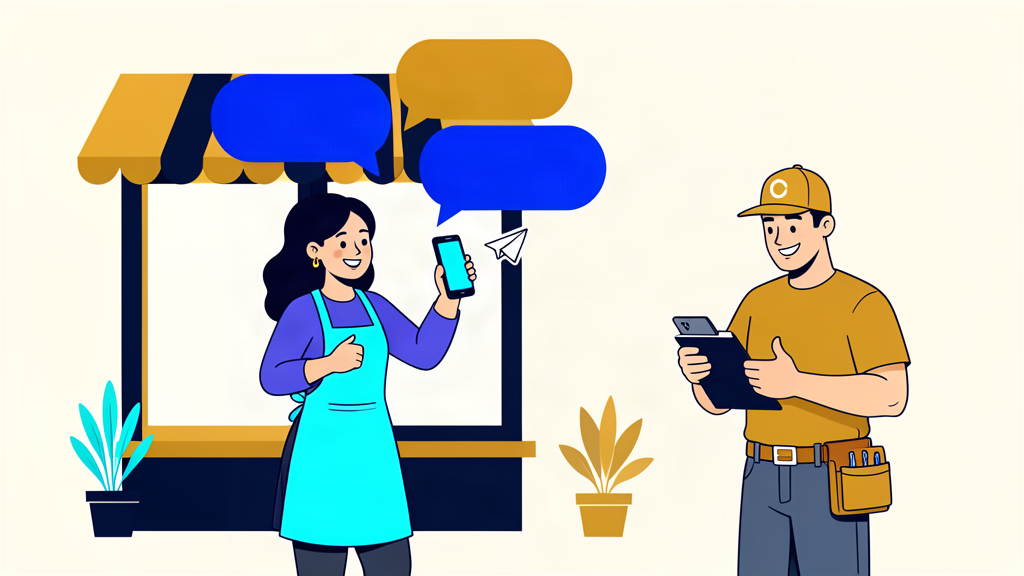
If you run a local business — a salon, a dental office, an auto shop, a plumbing company, a restaurant — you already have the most valuable marketing list in the world: your customers' phone numbers. Most of them are sitting in a booking system or a notebook, doing absolutely nothing.
Meanwhile, the average business email gets opened about 20% of the time. The average text message gets opened 98% of the time, and 90% of them are read within three minutes. That's not a small gap. That's a different sport.
Why SMS Beats Email (The Real Numbers)
- 98% open rate for SMS vs. roughly 20% for email
- 45% response rate on two-way text conversations vs. about 6% for email
- 90% read within 3 minutes — email gets checked over hours or days, if at all
- Appointment reminders by text cut no-shows by 30-40% in most service businesses we work with
For a service business, that third bullet is the whole ballgame. A lead that fills out your contact form at 9 PM has usually already called someone else by 9 AM. Text is the only channel fast enough to catch them while they're still deciding.
The Four Ways Local Businesses Should Actually Use SMS
1. Speed-to-lead follow-up
When someone submits a form or calls and you miss it, an automatic text goes out within 60 seconds: "Hi Sarah, this is Copperfield Plumbing — saw your request about the leaking faucet. What time works for a quick call?" Leads contacted within five minutes are dramatically more likely to convert than ones contacted an hour later. This is the single highest-ROI text you will ever send.
2. Appointment reminders and confirmations
Two texts: one at booking ("You're confirmed for Thursday at 2 PM — reply C to confirm") and one 24 hours before. Add a third a couple of hours out for high-value appointments. This alone pays for an automation setup in the first month for most clinics, salons, and trades businesses.
3. Review requests after the job
Send a text 2-4 hours after service with a direct link to your Google review page. Not the day before, not a week later — while the customer is still happy and still thinking about you. Businesses that do this consistently triple their review volume compared to asking in person.
4. Occasional promotions, not weekly spam
Once or twice a month, maximum. A restaurant texting "Two-for-one pasta this Thursday, reply YES to reserve" gets a real response rate. A restaurant texting every Tuesday gets blocked. The rule of thumb: for every promotion you send, send two useful messages (a reminder, a tip, a thank-you).
What You Can Send in Ontario (Consent Rules)
Canada has real anti-spam law — CASL — and texting is covered. But it's not complicated:
- Get consent. An opt-in checkbox at booking, a text-to-join keyword, or a signed service agreement counts. Buying a list does not.
- Identify yourself. Every message says who you are and why you're texting.
- Make opting out easy. Honor "STOP" instantly and keep the record.
- Keep it relevant. Business updates and reminders to people who've done business with you are fine. Non-stop promos to cold numbers are not.
Text marketing isn't about volume. It's about being the business that answers while everyone else is still checking voicemail.
Five Mistakes That Get You Blocked
Texting works because it's personal. Break that and it backfires fast. The mistakes we see most often:
- Sending too often. More than two promo texts a month and people opt out. Volume kills the channel.
- Walls of text. Keep messages under about 160 characters so they arrive as one clean text instead of three stitched fragments.
- No name, no context. "Hey, it's Sarah!" from an unknown number reads like spam. Always lead with your business name.
- No opt-out path. If "STOP" doesn't work instantly, you're breaking CASL and losing trust at the same time.
- Using a personal phone for bulk sends. Carriers flag numbers that send in volume. Business messaging providers exist for exactly this reason.
A local business owner sending 20 texts a day from their cell phone is fine. Sending 200 is how you get your number throttled — and that's a problem when it's also the number customers call.
What It Costs
Messages themselves are cheap — roughly one to two cents per text in Canada through a business SMS provider. The cost that matters is the system that sends them at the right moment: tied into your booking calendar, your contact forms, and your customer list.
That's the part most local businesses don't have. A website with booking and automated text follow-ups starts at $549 one-time or $125/month fully managed, live in 48 hours. No separate tools to stitch together, no monthly subscription stack.
A Simple Example
A 400-client hair salon sends one reminder text per appointment and one monthly promo. At a 30% no-show reduction on 120 appointments a month, that's 36 saved appointments. At $70 each, the reminders alone recover roughly $2,500 a month — for a system that costs less than a haircut per day.
Where to Start
- Collect consent at booking. One checkbox. That's your list.
- Automate the reminder. Highest impact, least risk, zero creativity required.
- Add speed-to-lead follow-up so no form submission goes unanswered for an hour.
- Then, and only then, start sending the occasional promotion.
Ready to get found online?
Get a free quote in 10 minutes. Your website live in 48 hours — with booking, reminders, and follow-ups built in.
Get a Free Quote →Questions? Call or text us at (647) 362-2017. We're a local Ontario agency that builds websites and automation for local businesses — plumbers to restaurants, salons to auto shops.